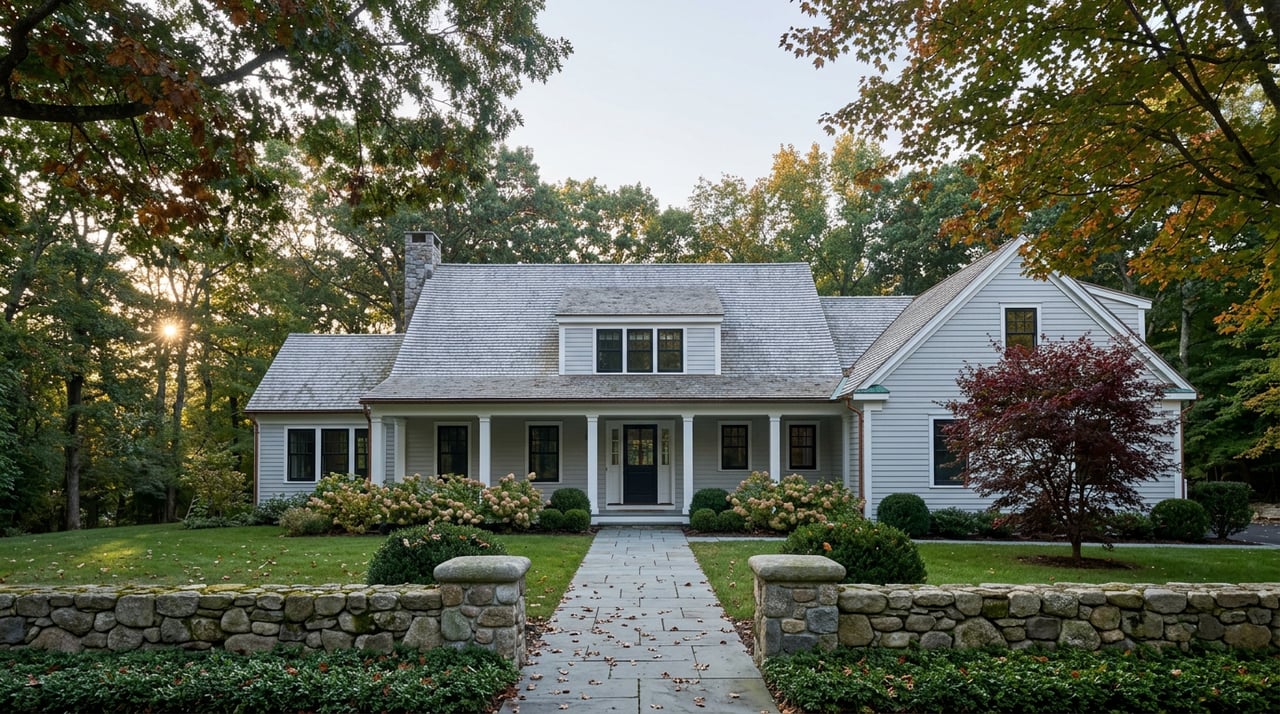
If you walk a dog in Easton, you already know the town is mostly woods and stone walls, more preserved acreage than paved road. What you may not have pieced together is that all that green space does not operate under one set of rules. It operates under several, and dogs are not allowed on the newest parcel the town protected.
The practical point is to check each preserve's rules before your next walk.
The One Loop That Gets to Run Free
Aspetuck Land Trust manages 45 trailed preserves spread across Easton, Weston, Westport, Fairfield, Southport, Norwalk, and Bridgeport, with a Monroe property on the way. Across nearly all of them, the land trust's own policy is leash on, six feet or shorter.
There is exactly one exception, and it lives inside Trout Brook Valley, the 1,009-acre preserve that straddles Easton and Weston and carries a 21-mile trail system. The Crow Hill section, a two-mile loop reachable from the Wells Hill and Freeborn Road parking areas, is the only off-leash trail Aspetuck operates anywhere in its territory. Everywhere else in that same 1,009-acre preserve, and everywhere else in the other 44 preserves, the leash rule holds.
That single detail changes how you plan a walk. If the goal is to let the dog actually run, Crow Hill is not one option among several. It is the option. Every other trailhead in town, no matter how empty the lot looks, defaults to leashed.
The land trust has good reason for the exception to stay narrow rather than expand. A 2012 wildlife study of Trout Brook Valley found enough sensitive habitat elsewhere in the preserve that the leash rule tightened almost everywhere except Crow Hill. Copperhead sightings have been reported on other trails in the preserve, and black bears have turned up in the woods there too. None of that is a reason to skip Trout Brook Valley. It is a reason to know which trail you are on before you unclip anything.
The Newest Protected Parcel in Town Doesn't Allow Dogs at All
Dog access varies by preserve. In 2023, Aspetuck Land Trust protected 18.7 acres along the Mill River, off South Park Avenue, using a Connecticut DEEP Open Space and Watershed Land Acquisition grant. The parcel secures 3,300 feet of riverfront and it happens to sit on one of only nine Class 1 Wild Trout Management Areas in the entire state.
That designation is why the land trust is asking visitors to leave dogs at home entirely when they visit. Not leashed. Not restricted to a side trail. Left at home. The cold-water fishery is delicate enough that even a leashed dog wading at the edge of the Mill River works against the reason the land was protected in the first place.
Together, these preserves illustrate how access rules vary across Easton.
The Leash-Only Middle Ground
Between those two poles sits a cluster of preserves off Maple Road that most dog walkers treat as interchangeable and are not. Paine Open Space, at 143.4 acres, is shared between the town of Easton and Aspetuck Land Trust, and dogs there must stay leashed. The adjoining Pond View and Island Pond preserves carry the same rule, enforced the same way.
There is a piece of Easton history tucked into that stretch of land that has nothing to do with dogs and is worth knowing anyway. A classic English hay barn once stood on the Paine property, built in 1847. The town raised funds to restore it, but a building inspector would not clear preservationists to get on the roof, and the restoration never happened. The barn was eventually offered for sale, and a Canterbury resident who owns a home built in 1712 took it with plans to rebuild it on his own property using the old foundation. Only the stone footprint remains on the Paine land today, a small reminder that this corner of town has been someone's working farmland for a very long time before it became a place to walk a dog on a leash.
What Changes in the Watershed This Fall
There is one more piece of the puzzle that is specific to this season, not a standing rule. Aquarion Water Company, together with Connecticut DEEP and The Nature Conservancy, finalized a 20-year Forest Resource Management Plan for the Easton Reservoir Block of Centennial Watershed State Forest, covering roughly 3,125 acres across Easton, Trumbull, and Monroe and running through 2045. Part of that plan is now underway. Aquarion has begun forest management work on Bibbins Road in Easton, designed to encourage a new generation of trees and improve long-term forest health.
The company held a guided site walk this past summer so residents could see the planned work firsthand and ask questions directly of Aquarion and DEEP staff. If you hike or walk a dog anywhere near Bibbins Road this fall and notice areas that look thinned out or freshly cut, that is the timber harvest phase of a plan that was years in the making, not a surprise.
Centennial Watershed itself is worth understanding on its own terms, since it is a different system from the Aspetuck Land Trust preserves even though the two sit close together on a map. The watershed spans more than 15,000 acres across Easton, Newtown, Redding, and Weston, and unlike the land trust properties, it requires a permit to enter. A hiking permit covers access to 17 miles of trails and doubles as your ticket to be on the property at all. Permits and maps are available at trailhead kiosks or at Aquarion's office at 714 Black Rock Road in Easton. It is a five minute errand, and it is the difference between a legal walk and a citation if a warden happens to check.
Knowing Which Ground You're On
None of this makes Easton less of a place to bring a dog. It makes it a town where the freedom depends entirely on which gate you parked at. Crow Hill is the release valve, two miles inside a much larger preserve where the rest of the trail system still expects a leash. Mill River is the newest and most protected ground in town, and it asks you to leave the dog in the car. Paine, Pond View, and Island Pond sit in between, open to dogs but only on leash, with a scrap of nineteenth century farm history built into the same acreage. And the Centennial Watershed land nearby runs on its own permit system entirely, currently in the middle of a fully public, twenty-year forest plan that is reshaping a piece of it this season.
The version of Easton people move here for, the one with more preserved land than paved road, is real. Dog access varies by preserve, and each place has its own rules. That is worth knowing before you clip the leash back on, or decide not to bring it at all.
If you are already navigating Easton's particular mix of open land, working farms, and quiet roads and find yourself thinking about what comes next for your own address here, Maura Gilson-O'Donnell would be glad to talk it through. Let's start a conversation.
This article is general information, not legal, tax or financial advice. Consult a qualified professional about your situation.